
How Doctors and Clinical Professionals Can Choose Professional Medical Scrubs
The best medical scrubs for doctors and clinical professionals should provide unrestricted movement, appropriate coverage, functional storage, and a polished appearance suited to the workplace. Fabric weight, stretch recovery, scrub-top length, waistband construction, pocket placement, and layering options should all be considered before choosing a uniform.
The right scrub set depends on the professional’s role, clinical environment, dress code, movement demands, and daily schedule. A physician working in an outpatient clinic may need different features than a surgeon, physician assistant, veterinarian, dentist, or emergency care professional.
Quick Answer
Doctors and other clinical professionals should look for scrubs that provide:
- A professional fit without restricting movement
- Breathable or lightweight fabric appropriate for the work setting
- Enough stretch for reaching, sitting, bending, and walking
- Secure pockets for frequently used lightweight items
- Appropriate neckline and torso coverage
- A comfortable waistband, rise, and inseam
- Layering options for changing temperatures
- Easy-care construction for frequent washing
- Colors and styling that comply with workplace policies
Scrubs should be tested through realistic movement rather than evaluated only while standing in front of a mirror.
Why Does Scrub Selection Matter for Doctors and Clinical Staff?
Doctors and clinical professionals work in a wide range of settings. These may include hospitals, physicians’ offices, outpatient clinics, urgent care facilities, surgical environments, dental practices, veterinary facilities, rehabilitation centers, and academic medical settings.
The U.S. Bureau of Labor Statistics notes that physicians and surgeons may work in both clinical and nonclinical settings, with clinical environments including hospitals and physicians’ offices. Physician assistants may also work across hospitals, outpatient clinics, medical offices, and other healthcare facilities. These different environments can create very different clothing requirements.
Scrubs worn during rounds, examinations, procedures, documentation, and patient consultations need to support several activities without creating avoidable distractions.
Poorly selected scrubs may cause:
- Pulling across the shoulders
- Waistband pressure during sitting
- Pants slipping when pockets are loaded
- Excess fabric around equipment or work surfaces
- Inadequate coverage when bending
- Overheating in active environments
- Difficulty accessing essential items
- An appearance that does not align with workplace expectations
Comfort is important, but professional presentation, practical storage, and workplace compliance matter as well.
How Should the Clinical Setting Influence Scrub Choice?
The first step is to identify where and how the scrubs will be worn.
Hospital and Inpatient Settings
Doctors working in hospitals may move between patient rooms, nursing stations, procedural areas, consultation spaces, and administrative locations.
Useful features may include:
- Flexible fabric
- Secure storage
- Comfortable walking fit
- Easy layering
- Wrinkle-resistant construction
- A waistband that remains stable during movement
- A scrub top that stays in place when reaching
Hospital environments may also vary in temperature. A lightweight scrub set combined with a removable jacket may provide more flexibility than a single heavy uniform.
Outpatient Clinics
Outpatient professionals often balance examination-room movement with patient consultations and documentation.
A clinic scrub set may place greater emphasis on:
- Clean professional lines
- Coordinated colors
- Moderate pocket storage
- Comfortable seated fit
- Consistent appearance
- Easy transitions between patient-facing and administrative tasks
A highly technical multi-pocket design may not be necessary when fewer items are carried directly on the uniform.
Emergency and Urgent Care Settings
Emergency and urgent care professionals may benefit from:
- Reliable stretch
- Secure waistbands
- Accessible pockets
- Lightweight fabric
- Minimal loose material
- Durable seams
- Scrub pants that remain stable during rapid movement
Pockets should remain easy to access without allowing stored items to swing, fall out, or pull the garment out of position.
Surgical and Procedural Environments
Scrub requirements in surgical or procedural areas may be determined by the facility.
Professionals should confirm:
- Approved colors
- Facility-issued garment requirements
- Changing procedures
- Restricted clothing areas
- Layering policies
- Laundry requirements
- Whether personal scrub garments are permitted
A personal preference should never override a facility’s infection-control, sterile-area, or uniform policy.
Dental Practices
Dental professionals frequently alternate between standing, sitting, leaning, reaching, and working in relatively fixed positions.
Helpful scrub features may include:
- Shoulder mobility
- Comfortable seated fit
- A neckline that remains secure when leaning forward
- Stretch through the back and arms
- Lightweight fabric
- Pockets that do not interfere with sitting
Veterinary Settings
Veterinary professionals may bend, kneel, reach, lift equipment, and work around animal hair.
Practical priorities may include:
- Durable fabric
- Secure pockets
- Flexible knees and hips
- Easy-care construction
- Fabric that does not require constant adjustment
- An appropriate balance between structure and movement
The ideal material and fit will still depend on the specific role and facility.
What Makes Medical Scrubs Look Professional?
Professional scrubs should look intentional, coordinated, and appropriate for the clinical setting.
Professionals selecting professional medical scrubs should evaluate both appearance and performance.
Important visual factors include:
- Proper shoulder alignment
- Appropriate sleeve length
- A neckline that provides consistent coverage
- A top that falls smoothly through the torso
- Pants with the correct rise and inseam
- Clean, functional pocket placement
- Fabric that maintains its shape
- Colors approved by the employer
Professional does not necessarily mean formal or highly fitted. A relaxed scrub set can still look polished when the proportions are correct and the garment is maintained properly.
Avoid Excessively Tight Scrubs
Scrubs may be too tight when they:
- Pull across the chest or shoulders
- Restrict sitting or bending
- Create tension at the side seams
- Prevent normal arm movement
- Stretch excessively across the thighs
- Require frequent adjustment
Avoid Excessively Loose Scrubs
Scrubs may be too loose when they:
- Shift significantly while bending
- Create excess material under jackets
- Obstruct pocket openings
- Drag near footwear
- Bunch behind the knees
- Catch on nearby objects
The goal is a controlled fit with enough room for normal clinical movement.
Which Scrub Fabrics Work Best for Clinical Professionals?
No single fabric blend is best for every doctor or clinical professional.
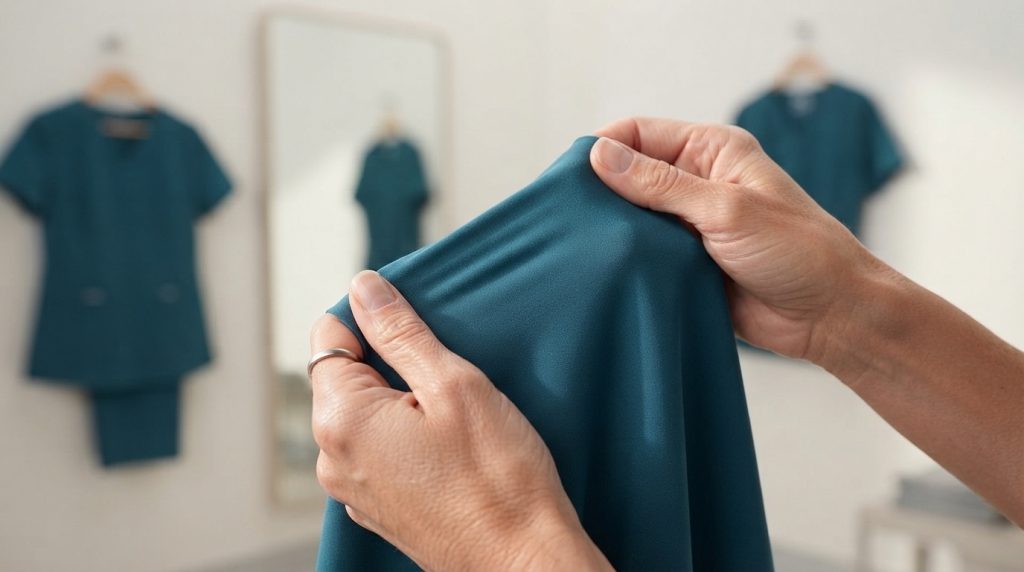
Fabric performance depends on:
- Fiber composition
- Textile construction
- Fabric weight
- Stretch percentage
- Moisture behavior
- Surface texture
- Finishing treatment
- Garment design
Two scrub sets with similar fiber percentages may feel very different because weight, weave, and construction also affect performance.
Polyester-Rich Fabrics
Polyester is frequently used in medical workwear because it can contribute to:
- Shape retention
- Wrinkle resistance
- Faster drying
- Smooth texture
- Color consistency
- Easy-care performance
However, not all polyester fabrics feel equally lightweight or breathable.
The actual garment should be evaluated rather than choosing based only on the fiber label.
Cotton Blends
Cotton can add softness and a familiar textile feel.
Cotton-blend scrubs may appeal to professionals who prefer:
- Less slick fabric
- A softer surface
- A traditional workwear feel
- Moderate structure
- Natural-feeling texture
Possible considerations include drying time, wrinkling, and shrinkage. The care label should be reviewed before purchase.
Rayon or Viscose Blends
Rayon-type fibers may contribute:
- Softness
- Fluid drape
- Flexibility
- A smooth feel against the skin
Professionals should check whether the fabric retains its shape and whether the drape is suitable for their workplace.
Stretch Fibers
Elastane or spandex can provide flexibility.
A small stretch percentage may be enough to support normal reaching, sitting, and bending. More stretch is not automatically better.
The fabric should return to its original position after movement rather than remaining loose at:
- Elbows
- Knees
- Seat
- Thighs
- Pocket openings
How Much Stretch Do Doctors and Clinical Professionals Need?
The required amount of stretch depends on the role.
A physician performing examinations, a physical therapist demonstrating movement, and a clinician completing seated consultations may have different mobility needs.
A practical scrub set should allow the wearer to:
- Reach both arms forward.
- Raise the arms overhead.
- Sit fully in a chair.
- Lean forward.
- Bend at the knees and hips.
- Walk quickly.
- Rotate the upper body.
- Reach across the body.
Stretch should support movement without making the garment feel excessively soft, loose, or unstructured.
Stretch Does Not Replace Safe Work Practices
Flexible clothing may reduce fabric restriction, but it does not make unsafe lifting or patient movement safe.
OSHA’s safe patient handling guidance emphasizes the importance of appropriate lifting and transfer equipment when moving, repositioning, or transferring patients. Clothing should therefore be treated as a comfort consideration, not as protective equipment or an ergonomic control.
How Should a Medical Scrub Top Fit?
A scrub top should support upper-body mobility while maintaining suitable coverage.
Check the Shoulders
The shoulder seam should generally sit near the natural shoulder area unless the garment is intentionally designed with dropped shoulders.
Test the top by reaching forward.
Warning signs include:
- Strong pulling across the upper back
- Tightness near the armholes
- The neckline moving upward
- The entire top shifting
- Restricted rotation
Evaluate Chest and Back Room
The top should provide enough room for breathing and movement without appearing oversized.
Look for:
- Smooth side seams
- No pulling around the chest
- Enough room through the upper back
- Minimal bunching under the arms
- Stable coverage while sitting
Test the Neckline
Common neckline styles include:
- V-neck
- Round neck
- Notched neck
- Mock-wrap
- Y-neck
- Zip neck
- Collar-style designs
The neckline should be tested while leaning forward, sitting, and reaching downward.
A neckline that appears appropriate while standing may shift during clinical tasks.
Check Scrub-Top Length
A top that is too short may rise significantly when reaching. A top that is too long may interfere with pant pockets or bunch at the hips while sitting.
Side vents can improve movement, particularly on longer scrub tops.
Tuckable vs Untucked Tops
A tuckable top may provide a more streamlined appearance and easier access to pant pockets.
An untucked top may offer:
- Additional coverage
- Larger lower pockets
- Less pressure around the waistband
- A more traditional scrub silhouette
The decision should reflect workplace expectations and personal comfort.
How Should Medical Scrub Pants Fit?
Scrub pants need to work at the waist, hips, thighs, knees, rise, and inseam.
A pant that fits at the waist may still be uncomfortable through the thighs. A fpant that looks correct while standing may create pressure when sitting.
Waistband
Common designs include:
- Full elastic
- Drawstring
- Elastic and drawstring
- Yoga-style waistband
- Rib-knit waistband
- Flat front with elastic sections
A waistband should stay secure without digging into the body.
Test it while:
- Standing
- Sitting
- Bending
- Walking
- Carrying normal lightweight pocket items
Rise
Rise affects how the pants sit between the waist and crotch.
A rise that is too short may pull during sitting. A rise that is too long may create bunching and excess fabric.
Professionals should compare the actual garment measurements because terms such as mid-rise and natural-rise can vary among collections.
Hip and Thigh Room
There should be enough room to sit, bend, and walk without excessive pulling.
Horizontal tension lines across the hips or thighs may indicate that the pants are too tight.
Large amounts of loose material may indicate that a different cut would fit more effectively.
Inseam
Incorrect inseam length can affect appearance, comfort, and practicality.
Common options include:
- Petite
- Short
- Regular
- Tall
The exact measurement associated with each term can vary.
Measure a well-fitting pair of pants from the crotch seam to the hem and compare it with the product sizing information.
Which Scrub Pant Style Is Most Professional?
Professional appearance is determined more by fit and workplace appropriateness than by a single leg shape.
Straight-Leg Scrub Pants
Straight-leg styles offer a traditional silhouette and may provide more room around the lower leg.
Tapered Scrub Pants
Tapered pants narrow gradually toward the ankle and can create a streamlined appearance.
Jogger Scrub Pants
Joggers typically include a narrow ankle opening or cuff.
They can reduce loose fabric around the lower leg, but the cuff should not feel restrictive or ride upward excessively.
Cargo Scrub Pants
Cargo pants provide additional thigh storage.
They may be useful for professionals who need more pockets, although overloaded cargo pockets can pull on the pant leg.
Flare or Bootcut Scrub Pants
These styles widen below the knee and may provide a more traditional apparel-inspired appearance.
The hem must be checked carefully to prevent dragging.
What Should Men Consider When Choosing Medical Scrubs?
Men should evaluate more than the basic size label.
The construction of medical scrubs for men may include different proportions through the shoulders, chest, torso, rise, thighs, and inseam.
Important measurements include:
- Chest
- Shoulder width
- Sleeve opening
- Torso length
- Waist
- Hip
- Rise
- Thigh
- Inseam
Men’s Scrub-Top Considerations
A men’s top should provide room through the shoulders and upper back without creating excessive width through the torso.
Professionals should test:
- Forward reaching
- Overhead reaching
- Sitting
- Upper-body rotation
- Access to chest and lower pockets
Men’s Scrub-Pant Considerations
Men’s scrub pants may be available in:
- Straight-leg cuts
- Joggers
- Cargo styles
- Tapered fits
- Short inseams
- Regular inseams
- Tall inseams
The waistband should remain secure when pockets are loaded, particularly when carrying a phone or work communication device.
How Many Pockets Do Doctors Need?
Pocket needs depend on the role and facility.
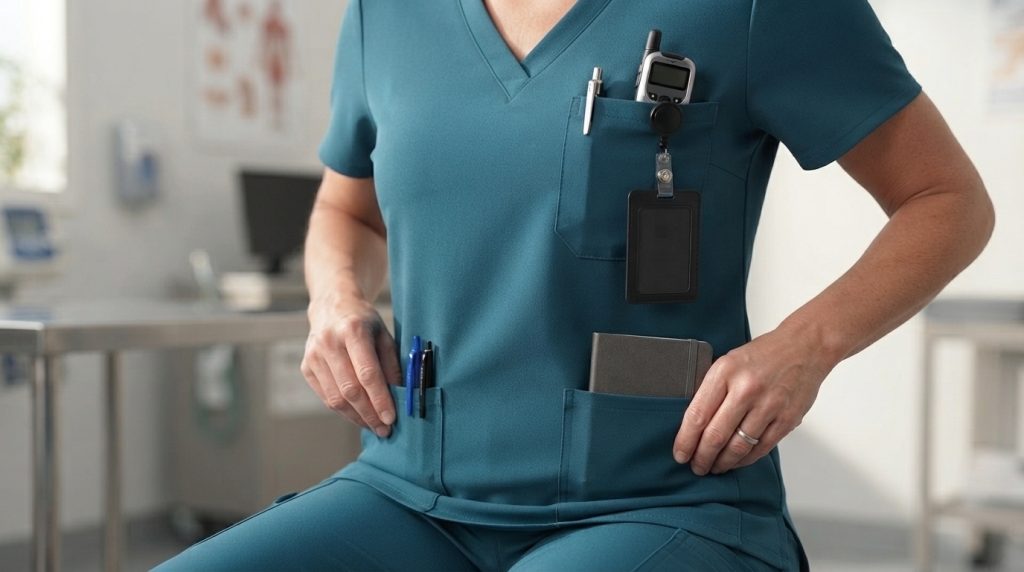
Possible items may include:
- Pens
- Small notebook
- Penlight
- Approved clinical tools
- Personal phone
- Work communication device
- Identification accessories
- Keys
- Small reference materials
Professionals should begin with an inventory of what they actually carry.
Chest Pockets
Chest pockets provide quick access to lightweight items.
Heavy items may pull the top forward or affect the neckline.
Lower Patch Pockets
Lower pockets provide more storage space and can distribute weight across the front of the top.
Cargo Pockets
Cargo pockets can provide useful storage along the thigh.
However, large objects may swing during walking or become uncomfortable while sitting.
Zippered Pockets
Zippered pockets may help secure a key, card, or other small item that should not fall out.
Interior Compartments
Interior dividers can keep pens and small accessories separated.
Pocket Placement Matters More Than Quantity
A garment with many poorly positioned pockets may be less useful than one with three accessible compartments.
Consider:
- Dominant hand
- Sitting position
- Jacket coverage
- Frequency of access
- Item weight
- Whether objects remain secure when bending
Avoid carrying sharp, contaminated, or facility-restricted objects in personal garment pockets.
When Should Clinical Professionals Wear Scrub Jackets?
Healthcare facilities can vary significantly in temperature, and professionals may move between warmer and cooler areas during the day.

Well-fitted medical scrub jackets can provide removable layering without replacing a required protective garment.
Common scrub jacket styles include:
- Zip-front jackets
- Snap-front jackets
- Warm-up jackets
- Knit-panel jackets
- Lightweight stretch jackets
- Track-style jackets
Features to Evaluate
Look for:
- Shoulder flexibility
- Sleeve length
- Cuff design
- Easy closure
- Pocket accessibility
- Appropriate jacket length
- Fabric weight
- Compatibility with the scrub top underneath
A jacket should not restrict the shoulders when reaching forward.
Scrub Jackets Are Not PPE
A standard scrub jacket should not be treated as a substitute for gowns, gloves, masks, eye protection, or other personal protective equipment required for a task.
The CDC’s Standard Precautions for All Patient Care explains that hand hygiene and appropriate PPE should be used based on the anticipated exposure to infectious materials. Workplace protocols determine when protective equipment is required.
How Should Scrubs Work With Lab Coats and Other Layers?
Doctors may wear scrubs under:
- Lab coats
- Scrub jackets
- Underscrub shirts
- Facility-approved outerwear
- Required protective equipment
The base scrub top should not become excessively bulky under an additional layer.
Test the Full Outfit
Try on the scrub set with the layers normally worn at work.
Then test:
- Shoulder movement
- Sleeve bunching
- Pocket access
- Neckline comfort
- Sitting
- Reaching
- Temperature comfort
A scrub top that fits correctly by itself may feel restrictive under a fitted lab coat.
Coordinate Pocket Use
When multiple layers have pockets, decide which items belong in each location.
Repeatedly moving items between a scrub top, jacket, and lab coat can create unnecessary clutter.
Are Breathable Scrubs Better for Doctors?
Breathable or lightweight fabrics can be helpful in active or warm environments.
However, lightweight fabric should still provide:
- Appropriate opacity
- Adequate coverage
- Shape retention
- Durability
- Workplace-appropriate appearance
Professionals should also consider whether they regularly wear:
- Underscrub layers
- Lab coats
- Protective gowns
- Jackets
- Other required equipment
A highly lightweight scrub set may be comfortable in one environment and too cool in another.
Layering flexibility is often more useful than selecting the heaviest possible base garment.
Should Doctors Choose Fitted or Relaxed Scrubs?
Both can be professional when sized correctly.
Fitted Scrubs
Fitted scrubs may provide:
- A tailored appearance
- Reduced excess fabric
- A modern silhouette
- Easier layering
They must still allow full movement.
Relaxed Scrubs
Relaxed scrubs may provide:
- More room through the torso
- Greater hip and thigh space
- Easier movement
- A traditional workwear fit
They should not be so loose that they shift or bunch.
Choose Proportional Fit
The best fit follows the body’s general shape without restricting normal activity.
A professional should be able to sit, reach, walk, and bend without pulling the garment back into position.
How Should Scrub Color Be Chosen?
Color selection may be controlled by:
- Department
- Job role
- Facility
- Employer branding
- School program
- Clinical placement
- Safety or identification policy
Before purchasing scrubs, confirm:
- Approved color names
- Whether shades must match exactly
- Whether tops and pants must be the same color
- Whether embroidery is required
- Whether prints are permitted
- Whether jackets must match the uniform
Two colors with similar names can look different across manufacturers.
Professionals working under a strict color policy should verify the exact approved shade or collection.
How Can Doctors Test Scrub Fit Before Buying?
A scrub set should be tested through several realistic positions.
The Clinical Scrub Fit Test
- Wear normal work underlayers.
- Put on typical work shoes.
- Sit fully in a chair.
- Reach forward with both arms.
- Raise both arms overhead.
- Bend carefully.
- Rotate the upper body.
- Walk quickly.
- Place lightweight items in the pockets.
- Add a lab coat or jacket when normally worn.
Then check:
- Shoulder tension
- Neckline coverage
- Top length
- Waistband pressure
- Pant rise
- Thigh mobility
- Inseam length
- Pocket stability
Professionals who prefer to compare fabric, fit, and inseam options in person may benefit from visiting a medical scrub store in Lincoln before choosing a complete workwear rotation.
How Should Medical Scrubs Be Purchased Online?
Online buying can be convenient when garment measurements are reviewed carefully.
Before purchasing, check:
- Size chart
- Chest measurement
- Waist measurement
- Hip measurement
- Rise
- Inseam
- Fabric composition
- Stretch description
- Pocket count
- Pocket placement
- Garment length
- Care instructions
- Return or exchange policy
Do not rely only on the usual letter size.
A professional may wear different sizes across:
- Brands
- Collections
- Scrub-top cuts
- Joggers
- Straight-leg pants
- Jackets
- Lab coats
Compare the size chart with a garment that already fits well.
What Common Scrub-Buying Mistakes Should Be Avoided?
Choosing Only by Appearance
A visually appealing scrub set may not provide the mobility, storage, or coverage required for clinical work.
Assuming Every Brand Fits the Same
Sizing and proportions vary.
Ignoring Seated Comfort
A waistband, rise, or jacket may feel different after several minutes of sitting.
Selecting Too Many Pockets
Unused pockets add bulk, while overloaded pockets distort the fit.
Ignoring Inseam Length
Incorrect pant length can affect comfort and appearance.
Buying Before Checking Dress Codes
Colors, embroidery, prints, jackets, and fits may be regulated by the employer.
Treating Scrub Jackets as Protective Equipment
A standard apparel layer is not a substitute for required PPE.
Buying a Complete Rotation Before Testing One Set
It is usually better to test a new style through a normal workday before purchasing several identical sets.
How Should a Professional Scrub Rotation Be Built?
Start by identifying a dependable combination of:
- Scrub-top cut
- Pant style
- Waistband
- Rise
- Inseam
- Fabric weight
- Pocket layout
- Approved color
Then determine how many sets are needed based on:
- Workdays per week
- Laundry frequency
- Employer requirements
- On-call responsibilities
- Need for backup clothing
- Seasonal layering
A practical rotation may include:
- Several core scrub sets
- One or two removable jackets
- Appropriate underscrub layers
- At least one backup set
- Separate garments required for specific environments
Consistency simplifies daily dressing, but professionals should still reassess fit as products, sizing, and workplace needs change.
Final Thoughts
Doctors and clinical professionals should choose scrubs as functional workwear rather than ordinary casual clothing.
The most important considerations are:
- Clinical setting
- Workplace dress code
- Shoulder and torso mobility
- Fabric weight and recovery
- Waistband and rise
- Inseam
- Pocket layout
- Layering requirements
- Care instructions
A well-selected scrub set should remain secure, provide practical coverage, support ordinary movement, and maintain a professional appearance throughout the workday.
The right choice is not necessarily the most expensive or most technical garment. It is the scrub set that fits the professional’s body, workplace, and daily responsibilities with the fewest compromises.
Frequently Asked Questions
What are the best scrubs for doctors?
The best scrubs for doctors provide professional coverage, comfortable stretch, useful storage, and an appropriate fit for the clinical setting. Doctors should consider movement, workplace temperature, layering, dress codes, pocket needs, and laundering requirements before selecting a scrub set.
Should doctors wear fitted or loose scrubs?
Doctors should choose a proportional fit that allows movement without excessive fabric. Fitted scrubs should not restrict reaching or sitting, while relaxed scrubs should not shift, bunch, or interfere with pockets and additional layers.
How many pockets should a doctor’s scrubs have?
The ideal number depends on what the doctor routinely carries. Pocket placement and security are more important than the total count. Lightweight items should remain accessible without pulling the scrub top or pants out of position.
Are jogger scrub pants appropriate for doctors?
Joggers can be appropriate when permitted by the workplace and fitted correctly. They reduce loose fabric near the ankle and can provide a modern appearance. The waistband, thigh room, cuff, rise, and inseam should be tested before purchase.
Can a scrub jacket replace a protective gown?
No. A standard scrub jacket is an apparel layer, not a substitute for required personal protective equipment. Protective gowns, gloves, masks, and eye protection should be used according to anticipated exposure and facility protocols.
What fabric is best for professional medical scrubs?
Polyester blends may support shape retention and easy care, cotton blends can provide softness, rayon may improve drape, and stretch fibers can add flexibility. The best fabric depends on temperature, movement, texture preference, workplace policy, and washing routine.